
Table of Contents
ToggleIntroduction
Every January, businesses begin the year with optimism.
Plans are developed. Targets are established. Teams are aligned around new objectives. Budgets are approved, initiatives are launched, and expectations are high.
Yet by June, something interesting happens.
Reality begins to replace assumptions.
Some projects move faster than expected. Others lose momentum. Market conditions evolve. Customer behaviour shifts. Internal priorities change. Opportunities emerge that were not part of the original plan.
This is why I have always viewed June as one of the most important months in the business calendar.
Not because it marks the midpoint of the year.
But because it provides a natural opportunity to pause, reassess, and realign.
The strongest organisations are rarely those that execute a January plan exactly as written. They are the ones that periodically review assumptions, adapt intelligently, and ensure that effort remains aligned with outcomes.
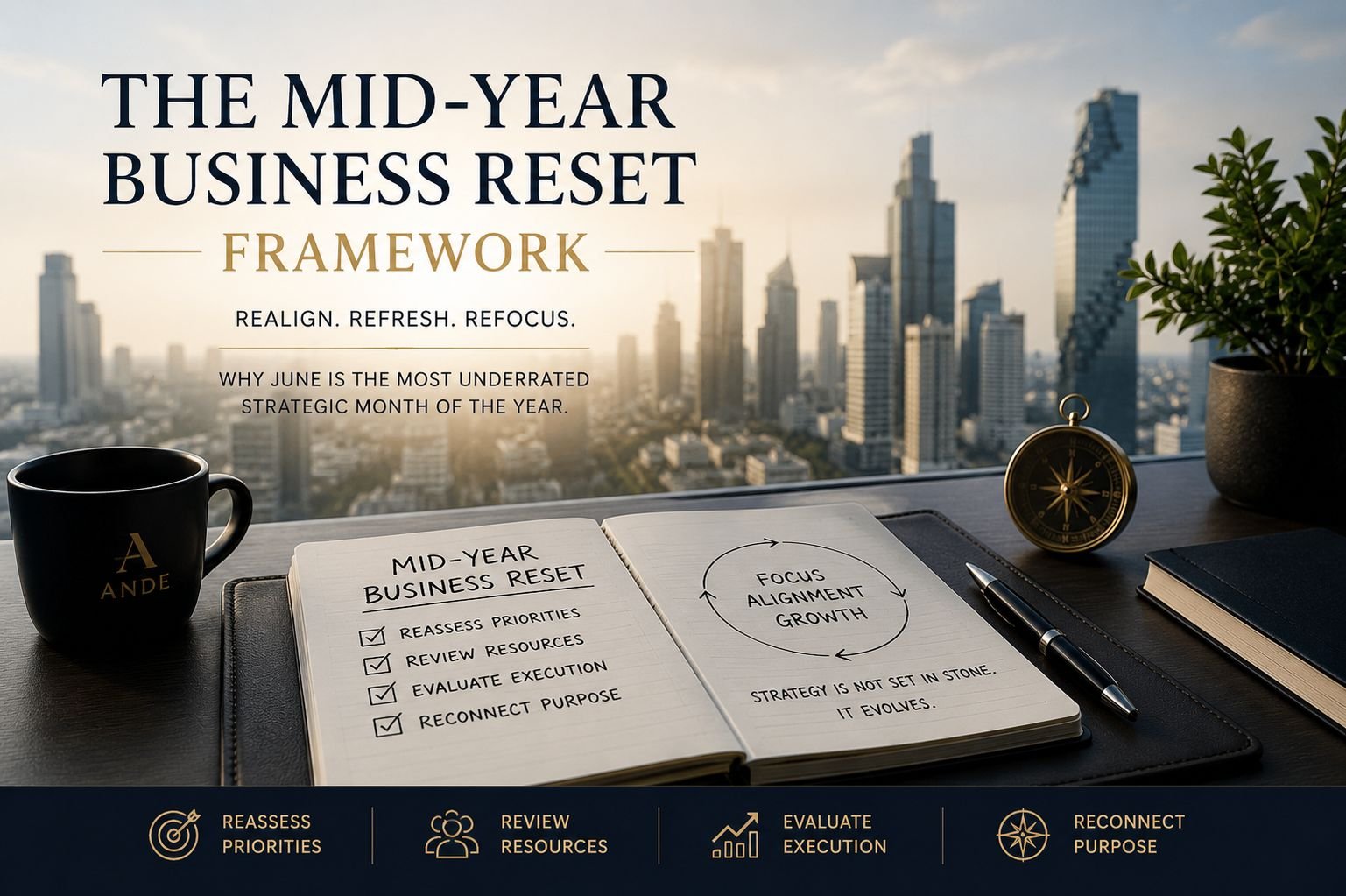
This is what I call the Mid-Year Business Reset.
Not a complete change of direction.
A strategic recalibration.
The Difference Between Activity and Progress
One of the most common leadership challenges is confusing activity with progress.
Teams are busy.
Meetings are taking place.
Projects are moving.
Reports are being generated.
From the outside, everything appears productive.
Yet beneath the surface, many organisations are simply maintaining motion rather than creating meaningful advancement.
Activity consumes resources.
Progress creates value.
The distinction matters.
A business can be extremely active while moving slowly toward its objectives.
Conversely, a focused organisation with fewer initiatives can often achieve significantly better outcomes.
This is why the first step in a mid-year reset is asking a simple question:
Are we busy, or are we progressing?
The answer is often more revealing than any dashboard.
Why Business Plans Lose Momentum
Most business plans do not fail because they are poorly designed.
They lose momentum because the environment changes.
A plan developed in January is based on a set of assumptions.
Those assumptions may include:
- Market demand
- Customer behaviour
- Economic conditions
- Team capability
- Capital availability
- Competitive landscape
By June, many of those assumptions have evolved.
The challenge is that organisations frequently continue executing the original plan without questioning whether the underlying assumptions remain valid.
This creates a gap between effort and relevance.
Leaders must recognise that strategy is not a document.
It is a living process.
The willingness to revisit assumptions is often what separates successful organisations from those that gradually drift off course.
The Four-Part Mid-Year Business Reset Framework
Over the years, I have found that most organisations benefit from reviewing four key areas at the midpoint of the year.
1. Reassess Strategic Priorities
The first question is straightforward:
What actually matters now?
Not six months ago.
Now.
Many businesses continue allocating time and resources toward initiatives that no longer carry the same strategic importance.
Priorities must be reviewed regularly.
A useful exercise is to list all major initiatives and ask:
- Which initiatives are producing results?
- Which initiatives remain strategically important?
- Which initiatives have become distractions?
The objective is not to add more priorities.
It is often to reduce them.
Focus is one of the most valuable strategic assets a business can possess.
2. Review Resource Allocation
Many organisations suffer not from lack of resources, but from fragmented resources.
People are spread across too many projects.
Budgets are distributed too widely.
Leadership attention becomes diluted.
The result is predictable:
Everything moves.
Nothing accelerates.
A mid-year reset provides an opportunity to reallocate resources toward initiatives that create the greatest impact.
This often requires difficult decisions.
But strategic clarity rarely emerges without trade-offs.
3. Evaluate Execution Quality
Execution is where strategy becomes reality.
A business may have excellent ideas and ambitious goals, but without effective execution, progress remains theoretical.
Mid-year is the ideal time to assess:
- Are projects being delivered on time?
- Are teams aligned?
- Are responsibilities clear?
- Are decisions being made efficiently?
Execution problems are rarely solved by working harder.
They are solved by improving structure.
4. Reconnect Teams With Purpose
As the year progresses, many teams become focused on tasks rather than outcomes.
People become busy.
Deadlines dominate attention.
The larger purpose becomes less visible.
A mid-year reset is an opportunity to reconnect people with the reason behind the work.
When teams understand purpose, execution improves.
When purpose is lost, activity often increases while engagement declines.
The Leadership Reset
The mid-year review should not focus exclusively on the business.
Leaders themselves require recalibration.
One question I often ask founders and executives is:
Are you spending your time on the work that only you can do?
Many leaders become trapped in operational complexity.
They attend meetings they do not need to attend.
They solve problems others should own.
They remain involved in decisions that could be delegated.
Over time, leadership becomes reactive.
The second half of the year presents an opportunity to reverse this trend.
A leadership reset involves:
- Simplifying responsibilities
- Clarifying decision ownership
- Focusing on strategic contribution
- Creating space for thinking
Good decisions require reflection.
Reflection requires space.
And space must be intentionally protected.
Why Thailand Remains Relevant in the Current Environment
For businesses operating in or entering Thailand, the mid-year review has additional significance.
The global environment continues to experience uncertainty.
Geopolitical tensions, supply-chain adjustments, technological disruption, and changing trade patterns are influencing business decisions worldwide.
Yet Thailand continues to demonstrate resilience.
Several factors support this position:
- Strategic location within ASEAN
- Established manufacturing ecosystem
- Mature infrastructure
- Access to regional markets
- Growing attractiveness for foreign investment
This does not eliminate challenges.
But it does create opportunities for businesses that approach the market thoughtfully.
For many companies, the second half of the year may be the ideal time to reassess regional expansion strategies and evaluate how Thailand fits into long-term plans.
Common Mistakes During a Mid-Year Review
There are several pitfalls leaders should avoid.
Mistake 1: Treating the Review as a Reporting Exercise
A reset is not about reviewing numbers alone.
It is about evaluating assumptions, priorities, and direction.
Mistake 2: Adding More Initiatives
Many organisations respond to slow progress by creating additional projects.
This often increases complexity.
The better response is usually greater focus.
Mistake 3: Avoiding Difficult Decisions
Mid-year reviews frequently reveal uncomfortable truths.
Ignoring them rarely improves outcomes.
Mistake 4: Focusing Only on Problems
A reset should identify strengths as well as weaknesses.
Understanding what is working is just as important as understanding what is not.
The Opportunity Ahead
The second half of the year often determines annual outcomes.
By June, enough information exists to evaluate reality.
Yet sufficient time remains to make meaningful adjustments.
This combination creates opportunity.
The organisations that use this period wisely gain clarity.
They simplify.
They focus.
They align resources with priorities.
Most importantly, they position themselves for stronger execution in the months ahead.
Final Thoughts
The purpose of a Mid-Year Business Reset is not to change direction unnecessarily.
It is to ensure that direction remains relevant.
Business environments evolve.
Markets shift.
Opportunities emerge.
The strongest leaders understand that strategy is not about rigid adherence to a plan.
It is about maintaining alignment between objectives, resources, execution, and reality.
As we move into the second half of the year, the question is not whether your business is active.
The question is whether it is moving in the right direction.
Sometimes the most valuable progress begins with a pause.
And often, the best time to pause is right now.